

VOLUME 22 ISSUE 1 / JANUARY 2025
Perhaps many are not aware that during the Theme Discernment Weekend, the CFC International Council agreed to two sets of verses from which to draw the 2025 Theme.
The main verses are:
Then they went away quickly from the tomb, fearful yet overjoyed, and ran to announce to his disciples …
Then Jesus said to them, “Do not be afraid. Go tell my brothers to go to Galilee, and there they will see me.”
Mt 28:8,10
The secondary verse is:
God sent his Son, born of a woman.
Gal 4:4
At first glance, these two sets of verses appear to be unrelated. But in fact, they are linked. The nexus is Galilee. It was in Galilee that Jesus called the apostles. And after his resurrection, he told them to go back to Galilee.
But there is another event – a defining moment in the history of salvation – that makes Galilee important. It was in Galilee that Mary gave her fiat:
The angel Gabriel was sent from God to a town in Galilee called Nazareth, to a virgin betrothed to a man named Joseph, of the house of David, and the virgin’s name was Mary.
Lk 1:26
Mary lived in Galilee
Mary accepted God’s will to be the mother of Jesus, our Lord and Savior. God sent his Son to be born of a woman. That woman is Mary. Mary of Galilee gave birth to Jesus of Nazareth.
The role of Mary is pivotal in salvation history. Thus, Pope Benedict XVI in a 2009 homily said: “When we reflect on this joyful mystery (Annunciation), it gives us hope, the same hope that God will continue to reach into our history, to act with creative power so as to achieve goals which by human reckoning seem impossible.”
Pope Francis echoed the words of his predecessor: “We must fan the flame of hope that has been given us and help everyone to gain new strength by looking to the future with an open spirit, a trusting heart and far-sighted vision.”
Thus, this Jubilee Year 2025, we respond to Jesus’ call to return to our Galilee as pilgrims of hope, imitating the trusting heart of Mary.
Mary, our Lady of Hope
We imitate Mary because she is Our Lady of Hope. This is the title given to the Blessed Virgin Mary following her apparition in Pontmain, France on 17 January 1871. During the Franco-Prussian War, Mary appeared to the villagers in Pontmain as the Prussian troops approached the village. The villagers prayed and repeatedly sang the hymn:
“Mother of Hope, Whose name is so sweet. Protect our land. Pray, pray for us.”
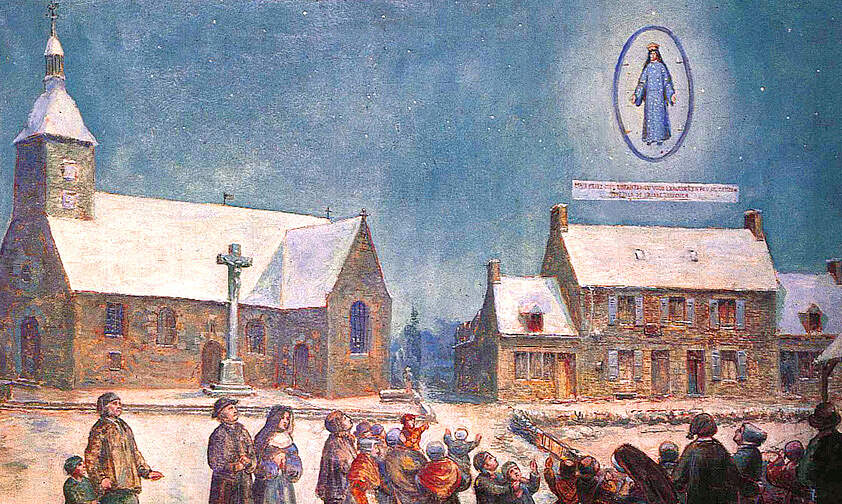
Miraculously, the Prussian troops withdrew.
In the morning of the following day, the Prussian general is reported to have said: “We cannot go farther. Yonder, in the direction of Brittany, there is an invisible Madonna barring the way.” And shortly thereafter, on 23 January 1871, the long-hoped-for armistice was signed.
In 1932, Pope Pius XI granted a Mass and Office proper to our Lady of Hope of Pontmain. On 16 July 1932, Cardinal Pacelli, who later became Pope Pius XII, passes a decree to Pontifically crown the statue of Our Lady of Hope.
Years later, on 24 July 1934, the image of Our Lady is crowned by Cardinal Verdier, Archbishop of Paris, in the presence of archbishops, bishops, priests and the laity.
Mary’s Fiat, our “Yes”
Returning to Galilee means returning to our roots. It means returning to Mary’s fiat. And personally, it means returning to our own fiat when we signed our covenant card in Couples for Christ.
It means, among others, but most importantly, observing our personal daily prayer time, daily reading, studying and reflecting on the Holy Scriptures, regularly celebrating the Lord’s Day with our family, and faithfully attending our household prayer meetings.
Returning to Galilee also means returning to the task given by Jesus to his disciples. For us in the community, it means returning to the very core purpose of Couples for Christ.
This core purpose is revealed in the call of the first disciples:
As Jesus was walking by the Sea of Galilee, he saw two brothers, Simon who is called Peter, and his brother Andrew, casting a net into the sea; they were fishermen. He said to them, “Come after me, I will make you fishers of men.”
Mt 4:18-22
At once they left their nets and followed him. He walked along from there and saw two other brothers, James, the son of Zebedee, and his brother John. They were in a boat, with their father Zebedee, mending their nets. He called them, and immediately they left their boat and their father and followed him.
CFC’s Evangelical work
Evangelization and pastoral care are the core tasks of our community. We cast the net to catch people and bring them into the community. This is evangelization. We mend the net to remove the holes that may cause people to be lost from our community. This needs pastoral care.
St. Pope Paul VI in Evangelii Nuntiandi tells us that the first means of evangelization is the witness of an authentically Christian life, given over to God in a communion that nothing should destroy and at the same time given to one’s neighbor with limitless zeal.
In the same document, he defines evangelization as the carrying forth of the good news to every sector of the human race that by its strength it may enter into the hearts of men and renew the human race.
This means that evangelization does not depend so much on our skill, talent, preparation, planning, or organization but on the inherent strength of the word of God. We are mere carriers of God’s word.
On the other hand, Pope Francis in Evangelii Gaudium teaches that pastoral care for our members must come from “our personal experience of being accompanied and assisted, and of openness to those who accompany us; it will teach us to be patient and compassionate with others, and to find the right way to gain their trust, their openness and their readiness to grow.”
In the same document, Pope Francis tells us that “there is a Marian style to the Church’s work of evangelization and pastoral care … Mary is the missionary who draws near to us and accompanies us throughout life, opening our hearts to faith by her maternal love.”
Brothers and sisters, as pilgrims of hope, we should focus on our basic task of evangelization and pastoral care accompanied by Our Lady of Hope, as we go back to our own Galilee.